

Story by Holt Keystone
Illustrations by Samuel Mancier
This story and illustrations were originally published in the July 1928 issue of Odd Stories Magazine. This version differs slightly, though not substantially in plot, from that which has appeared in subsequent publications. This is due to the infamous editorial liberties of Elijah Dayne Koco, founder and longtime editor of Odd Stories. He had a habit of “trimming the fat” on accepted submissions, often without the author’s blessing or knowledge. Though this regularly stung the pride of those who saw their altered works published in Odd Stories, most, including Keystone, begrudgingly admitted to the improved flow and pace achieved by Koco’s choices.
Be sure to read PART 1 and PART 2 before reading the below.
Gathering the bulk of my tenants together in one place proved easy. But then, they had reason to trust my intentions, as I had, for more than two decades, provided an annual Christmastime dinner to any and all under my roofs. So, a similar communal feast seemed likely to entice. And billing it as a banquet of appreciation for such fine, responsible tenants would not, I felt, strike any of them as out of the ordinary.
Needing a large space, but one I could control in all aspects, I opted to host the feast in my familial home. It was, at the time of its construction, the finest Georgian plantation manor west of Savannah. My family, as sole owners, had maintained the requisite pride necessary for proper care in its upkeep and expansion, including that of its oversize dining hall. The detached summer kitchen proved particularly efficacious, allowing my crew of chefs and cooks to prepare the food without any contact with the guests. The meal was presented buffet-style, thus dispensing with the need or expense of a waitstaff. This also allowed me to send my regular staff of servants home as soon as the last dish was placed in the hall.
As for the post-banquet cleanup, I rightly expected the police to provide those services.
For the meal itself, I’d chosen cuisines with bases and spices producing quite pungent, yet appetizing, aromas. Augmenting the desired aromatic saturation of the hall’s air was bouquet after bouquet of flowers of strong, pleasant scents. Placed both in the hall itself and within the adjoining passages, these masses of blooms made an indoor garden of the space. Small industrial fans set to their lowest power aided the high-set ceiling fans in keeping the fragrant air cool and continuously circulating. And good nails and fresh paint sealed up any errant cracks around the windows.
The effect was so successful that, for a time, even I forgot about the gas slowly filling the room.
It was sheer luck that, though I’d long since replaced the gas lighting with electric, the manor’s heating system still ran on gas. An innocuous conversation with my doctor garnered me the knowledge necessary to calculate fatal exposure limits in terms of quantity and time. And opening all the valves without lighting the pilot light was a simple but effective way to ensure even dispersal of the gas. Blowing out the canned heat beneath the chafing dishes, as well as forbiddening any smoking during the meal, was a final precaution. Part of me worried that a stray spark from the electric lights or fans would set off the gas, but I knew it was better for my tenants to burn than fall to the Traveler.
With everything else in place, I made to exit the room. No excuse was needed, as I had been flitting in and out all evening on the pretense of attending to the various duties of a host. But on this final retreat from the room, some still undefined feeling made me stop and turn before stepping into the hall. Was it sympathy for my tenants? Or was it just a lingering reluctance at committing what would surely be judged as the cruel act of a criminal until the powers that be became aware of the Traveler, at which point my act would be seen as the heroic, self-sacrificial deed that it was? Even now, I’ve no answer for why I paused in that doorway. But considering that I’m now strapped to this bed, my prediction of harsh judgement for my so-called crime has proven correct, and I anxiously await the moment when the latter prediction sees me freed from this same bed.
But whether out of pity or hesitancy, I did stop and turn and look upon my oblivious flock. Beneath their frivolity and smiles at the fine food of which they were partaking, I saw a weariness I had not previously perceived. There was a sunkenness of cheek, a sallowness of skin. Dark circles surrounded all eyes, under which sagging skin refuted the liveliness otherwise on display. Rough, scarred hands worked fork and knife, spoon and ladle. Thin, wiry limbs shook ever so slightly to bring cup and glass to lips that ran with the momentary color of coffee or wine before returning to their dry, pale state. Dirt showed beneath ragged fingernails, and even the women’s hair had a straw-like cast that spoke of infrequent scrubbing with shampoos of poor quality. The elbows and knees of out-of-fashion suits bore patchwork sewn and resewn with threads and textiles unworthy of the care their seamstresses showed, and every dress wore the tell-tale yellowing of age joined with too few washings.
The natural dignity and health-giving properties of hard, daily labor in which I have always put my faith and from which I have long benefitted had fully fled from this sad lot. Here was an exhausted, sickly people. Had they always been this way? Surely, I would have noticed. No! What I saw there was not wholly unlike what had greeted me every morning and night in my mirror.
There could be no longer be any doubt; they had, to a one, gazed upon the Traveler! How long they had silently borne this sleep-induced affliction was impossible to guess. And they had remained silent about it. Of that, I was certain, for I’d heard no report of any tenants being dragged from their apartment or place of employment and deposited in this or some other madhouse. Talk of the Traveler to the uninitiated could, of course, lead to no other end.
These poor souls had kept this dreadful knowledge to themselves, though all about them dwelt others who could have commiserated with them, who could have both granted and received validation. But in doing so, they had endangered us all. Considering that some of them worked the graveyard shift and dreamt away the sunlit hours, can it be denied that the Traveler was now likely to move at all hours, to bear down upon our world in constancy, no longer encumbered by any shroud of light.
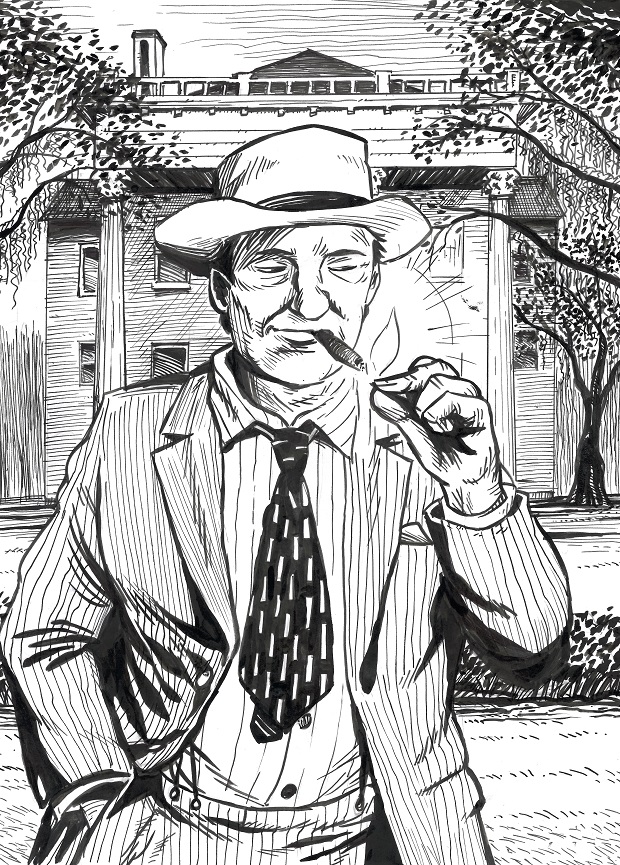
At this realization, I delayed no further in crossing the threshold into the hallway, locking first the doors to the dining hall, then all nearby exits. With all hope of escape safely removed from my guests, I exited the manor through the front double-doors, closing and locking them behind me. I then lit up a fine cigarillo, and, breathing calmly of its flavorful vapors, I waited.
Once the muffled sounds of struggling ceased, I turned off the main valve feeding the entire manor. Some broken window panes, additional fans set on high, and a few minutes more patience saw the real work begin. After calling the police, with an additional request for as many ambulance wagons as they could spare, I made a fire in the banquet hall’s central hearth. The rest was cinched up before help arrived.
Had I merely gassed my tenants to unconsciousness, my present circumstances might be different. I’d likely be in the penitentiary, with a still severe but less permanent sentence. It does appear a few of my so-called victims have permanent damage to their mental faculties. Several more died in the process, mainly due to a weakness of constitution, which, I’m sure you would agree, must be blamed upon the effects of their having repeatedly seen the Traveler. But as my attorney convincingly argued, this was all merely an unfortunate but unintended side effect of my true aims. While not irrelevant, it did not add the greater weight to my sentence.
No, it was neither the sedation nor manslaughter of my tenants that saw me unfittingly banished to this madhouse. It was the taking of their eyelids.
And my own.
The prosecutor himself seemed little motivated to seek a purely criminal conviction, and had much to say about my upstanding reputation as a businessman and philanthropist, and about my family’s legacy and ties to the city. As with my own attorney, the prosecutor viewed the maiming after the act as lunacy. The jurors concurred. Even the judge seemed to show me pity.
Good men, all. I only wish I could warn them of what’s to come. Not that it would do any good. I know that now.
♦
There’s little more to say, really. I threw most of the lids into the fire, but kept a few as reminders of my necessary sin. As penance. I hoped to have them here, having secreted them in my watch pocket. But the orderlies were thorough. They mistook them for shriveled scraps of rubber until they noticed the lashes with which they bristled.
It’s just as well. Had this straitjacket any pockets, I wouldn’t be able to reach them. Nor could I properly appreciate my souvenirs, as my own eyesight is slowly failing to blindness.
This mask of gauze and whatever odorous unguent coats it eases the pain and discomfort. Above all, it allows enough light through to block out the Traveler.
The Brute’s saliva doesn’t help, I’m sure. He’s made a habit of spitting onto the gauze over each eye whenever no one’s watching. Or so I must assume. I’ve only my ears and skin and the passing shadows to tell me of the world beyond this bed.
I’d happily accept the Brute’s unpredictable bursts of cruelty if I thought they were directed solely at me. I am wholly deserving of such treatment. But I’ve heard enough shouts and screams above his laughter to know neither preference nor justice stays his barbarous hand. However, when the other orderlies told the Brute what they’d found in my pocket, he was far more prejudicial in his attentions than usual. I welcomed this particular abuse, of course, and count my broken nose as a fitting reminder of my loving crime. I did worry that first night, though, that I might choke upon my own blood while slumbering. But no such mercy came.
If my injury has worsened my snoring, I apologize. But then, I doubt you’d tell me. I know you’re still there. I hear you breathing. And groaning. But not a word from you.
Some of what the Brute said about you must be true, then. Whatever terror brought you here stole your speech. I’ll probably never learn if your injury is physical or psychological. Still, despite how gleefully insistent the Brute was about the idea, and despite my willingness to add your quiet suffering to my list of punishments, I don’t believe you’re one of mine.
No, Dr. Walls wouldn’t be so cruel or foolish as to imprison a criminal and his victim together. What would feel inhumane to me would feel doubly so for you. No, my dear roommate, you’re the product of some other dark misfortune.
It’s of little matter. Our misfortunes are now intertwined, as, I fear, they are with all sentient life of this planet. All planets, perhaps, if life exists elsewhere.
The Traveler comes for us all. Nothing can prevent its advent now. And if, at the onset of sleep, you haven’t yet laid eyes on the Traveler, you may trust that you soon will.
As will I, even after the futile gesture of my knife has finally shut my corporeal eyes forever. For there is another eye within all conscious beings. I know nothing of its shape or color, or of the otherworldly nature of its lens. But its mass lies wholly or in part within a universe far stranger and vaster than our own. The veins and nerve fibers of that eye pierce the delicate membrane separating our two realities. Those same veins and fibers seem to be rooted deeply within the oldest parts of the human brain, carrying to them every blasphemous vision this other world has to affront our senses. And I know all too well that, once opened, this eye can never again be shut except, perhaps, by death.
Or is this vision a preview of what awaits us after death?
No. No! I cannot, will not believe that. There must be some escape from the Traveler. From this common fate.
Oh, that the Brute would show some of the same cruel kindness I showered upon my tenants. Come, dear Brute, put me out of my long misery! Send me fully into the dark and, in doing so, save me from that which lives and hungers and stalks in that other dark.
But, dear Brute, do it soon. For only last night, the Traveler had approached near enough that I know, with all the certitude of despair, that the fiend shall grab hold of me the moment I next gaze upon its sanity-numbing form. It loomed impossibly large, fully encompassing my field of vision. Every crease and crack in its hide was a fright-filled canyon of impenetrable depth. But most dreadful of all, my sense of sight in that terrible place had been joined by my sense of touch.
I could feel the Traveler’s hot, reeking breath on my flesh as it blew to me from across the Living Void! And, oh, how it burned my staring, tearless, lidless eyes!
But, no, Brute. You bring no mercy, do you? Only my doom. I take no comfort in the fact that you, too, will face this same doom in due time, for such can also be said of the countless souls who are far less deserving than you of such a horrid end.
Do you hear The Brute now, my silent companion? You must. His words ring clear as any belfry’s death knell. Only two words, repeated over and over and over again. And they swell to bursting with more malicious foulness than any curse in any tongue. With each repetition, they decrease ever so slightly, ever so tauntingly in speed of utterance, while gaining in pitch and in the awful glee they carry from their speaker. It is the bestial melody of the schoolyard bully destined for capital punishment. It is the careless cadence of the murderous stalker in the wilderness, calm in the knowledge his victim’s pleas will reach no salvific ear.
“Lights out,” cries the Brute!
”Lights out! Lights! Out! LIGHTS! OUT!”
About the Author
Holt Archambaud Keystone was born in the fall of 1901 on a plantation manor in the Appalachian foothills of Georgia’s legend-haunted Red Wolf River Valley. After convalescing from injuries sustained as a soldier in WWI, he limped his way across Europe, the Middle East, and much of Asia, all while honing his skills as a writer. Though true fame and critical praise only came posthumously, Keystone was hailed by his contemporaries for his prose and poetry, particularly in the genres of weird fiction, dark fantasy, and “sword and sorcery”.
The darkly irreverent cosmic nihilism he displayed in much of his work saw him affectionately referred to as The Gentleman Blasphemer by none other than Samuel “Skipper” Clemens. In his controversial biography of Keystone, author Lymon W. Lyon described the man as “what might have happened had Lovecraft grown up in the Jim Crow South, traveled the world by foot, and bothered actually getting to know the various races and cultures the Old Man from Providence feared and despised.”
Due to the eerily prescient nature of some of his work, Keystone also earned the moniker of Great Prophet of the South. This and other aspects of his life led to rumors of psychic abilities or even divination via the same dark forces about which he wrote. This reputation has only grown since his untimely death and purported cannibalism at the hands of his murderously insane mother in 1930.
All of the preceding facts are true. Just not in our universe.
In our universe, this story was written by Kevin Scott Joiner, a co-creator of the excellent Cosmic Horror Podcast, Forbidden Cassettes: Consummation. You can read the unedited version of this story and support his creative endeavors at his Silk House Productions Patreon Page.
Alan Hughes is a teacher and artist from north Georgia. He is the man behind the illustrations done by Samuel Mancier. When not drawing monsters, he likes talking about them on The Lovecraft eZine Podcast. You can see more of his work on his Instagram Page.
[…] To Be Continued…in PART 3 […]