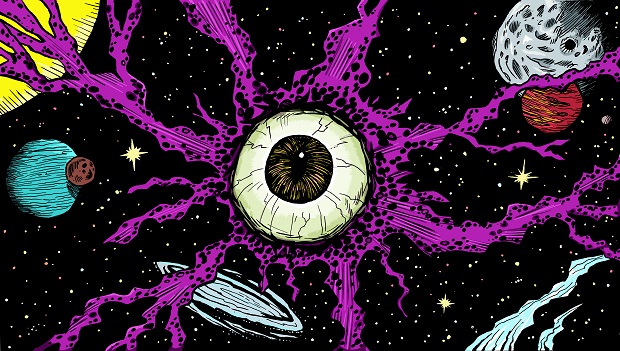
Story by Holt Keystone Illustrations by Samuel Mancier This story and the illustrations were originally published in the July 1928 issue of Odd Stories Magazine. This version differs slightly, though not substantially in plot, from
Story by Holt Keystone
Illustrations by Samuel Mancier
This story and the illustrations were originally published in the July 1928 issue of Odd Stories Magazine. This version differs slightly, though not substantially in plot, from that which has appeared in subsequent publications. This is due to the infamous editorial liberties of Elijah Dayne Koco, founder and longtime editor of Odd Stories. He had a habit of “trimming the fat” on accepted submissions, often without the author’s blessing or knowledge. Though this regularly stung the pride of those who saw their altered works published in Odd Stories, most, including Keystone, begrudgingly admitted to the improved flow and pace achieved by Koco’s choices.
Part 1
The Brute says you can’t talk, but I know what you must be thinking. How long since I last slept? I can’t know. Time’s clean borders bleed their contents when wakefulness stretches beyond a sunrise or two. Thinking upon all that’s happened since the bloody banquet, I’d guess it’s been at or near a week. It must still be 1922. The aggressive barking of self-righteous detectives and my lawyer’s droning jargon made those first few days feel longer than they were. But, yes, I think around a week without sleep is right.
It’s said that any stretch of sleeplessness beyond two or three days can bring on a psychotic, hallucinatory madness. Exhausted as I am, I can see how that might often be the case. But madness hasn’t taken hold of me yet. I have truth and purpose keeping me sane!
Even then, it hasn’t been easy to hold onto reason and self, thanks in no small part to a certain orderly stalking these halls. Having only just arrived in this place, you can’t know of whom I speak. But you will. Of that, there can be no doubt. I only hope, for your sake, he doesn’t take a special interest in you as he has done with me.
Do you hear him? The cruel one? The Brute!
I hear him well. His voice is raised. It’s almost always raised. But that’s no cause for concern. It’s when his voice goes calm and soft that you should worry.
His voice is faint, too. Distant. Guttural echoes rushing through the labyrinthine hallways separating us from him.
Those same echoes only serve to muddy his words beyond intelligibility. That won’t last. We’ll understand him soon enough. It’s as inevitable as sleep.
Ah, sleep. I fear it more than the Brute! More than anything.
No! Untrue! Forgive me, I beg. I didn’t lie, but only just realized it isn’t sleep I fear, but that which sleep must surely bring. That’s why I acted so desperately to banish sleep from myself.
From others.
It’s why my insomnia predates my incarceration here. The incident that put me here was heralded by several months of my deliberate attempts to avoid sleep. Whenever these attempts failed, they were replaced by long, terror-laden nights punctuated by wakeful fits and starts. All was misfortune. But whether one misfortune preceded the other or they arrived together, I can’t say. What I can say is this restlessness fell upon me about the time I first shut my weary eyes to find myself gazing upon the Traveler.
It was in the spring of this year. You recall, I’m sure, how the long winter brought snow into the middle of May before the clinging chill receded enough to trade the evening fire for open windows. This saw the vernal blooms come late. I remember drifting off to the ambrosia of fresh honeysuckle. Magnolia. Orange blossom. The subtropical heat of southern Georgia was not yet sufficient to dull the heavy, lulling sweetness they bring to a night’s repose.
Midnight passed before sleep overtook me, and the Traveler came dimly into my view. I’d only just descended to the threshold of true slumber, that which the alienists term, hypnagogia. But those bespectacled head doctors have long dismissed the possible reality of visions arising between wakefulness and sleep. Even Jung, while noting their importance, considered them merely the imaginings of a sleep-addled mind.
This same lack of insight in my former alienest is partially to blame for the cruel kindness that brought me to this asylum. Had he offered a poppy seed of faithfulness in me, or taken steps to seek the opinion of other scholars, another course of action might have presented itself. Certainly, much bloodletting and pain would have been avoided. At the very least, none of what I fear will come to pass at the final advent of the Traveler would have been upon our hands.
But I was left to my own devices about how best to address the present danger, and only through the caring, if misguided, testimony of that same alienest was I declared mentally unsound. Please, don’t take my ramblings as ingratitude. Had that doctor not pled my case, I might be swaying from a gallow tree, or strapped to the newly christened “Old Sparky” at the nearby penitentiary rather than to this stiff bed. So, though I shouldn’t be counted among the lunatics, idiots, or epileptics for whom this hospital was built, I’m quite content to live among them.
I should note that my courtroom diagnosis of violent mania goes unchallenged by my new alienest. I like the man. He has a good heart and a talented mind. But he refuses to accept the threat we all face. As my first head doctor demonstrated, convincing anyone of this threat, especially those with the authority and means to act, is so much wasted breath.
Convince them? No. Protect them? Perhaps.
I certainly thought so at the time and felt it my duty to try. It was this same sense of obligation that led me to attempt the salvation of my tenants.
♦
I’ve always tried to be a fair landlord. Generous, even. And it’s been my habit to choose the welfare of my tenants over that of any of my three tenement houses. But then, I’ve never really been faced with that difficult decision, graced as I am with the same aptitude for business that carried my father to lifelong success.
Necessary repairs, for example, have generally been rendered well before a state of true disrepair presents itself.
I’ve been likewise industrious with all legally mandated updates to my structures, often going above and beyond requirements. For instance, my buildings were among the first in the city to install electric lighting. And despite rumors to the contrary, it had nothing to do with that terrible case of gas poisoning a few weeks before the first building’s installation. As my defense clearly showed, I’d submitted for the proper permits well before the incident. And anyway, I can’t be held responsible if the father of that poor family had an out-of-fashion and, frankly, out-of-class penchant for wearing top hats.
Like that Pennsylvanian man at Chicago’s Palmer House several decades ago, my tenant had unknowingly brushed his top hat against the lever controlling the gas flow to a fixture just inside his front door. I was present when the hat was found nestled in its bandbox, which was itself underneath a pile of blankets, all atop a tall wardrobe. I saw with my own eyes the long, thin scratch on that hat, cutting right through its dusty fur.
Unfortunately, the tenant had likely been tight at the time, as was his habit most Friday and Saturday evenings. How he managed always to sober up before taking a seat in the Sunday pews, I’ll never know. But his fellow congregants had no inkling of his taste for the sauce. Had he not been inebriated, he might’ve fought his gassed stupor long enough to open a window, or crawl into the cleaner air of the hallway and gather strength enough to go back for his family. But such was not to be. His fate, along with that of his wife and five children, was sealed as tightly as the apartment’s window sashes.
It’s a pitiful affair, no doubt. But had it not happened, I might not have devised the method by which I attempted to save my tenants from the menace of the Traveler. And guilt or no guilt, I made quick work of replacing that building’s worn copper lines with quality knob-and-tube wiring. The other two buildings followed suit a year or so later.
As I said, I’m industrious with such matters.
I bring all this up to say I’ve taken pains to treat my tenants as my own. Indeed, for those tenants I felt had, through their own industriousness, earned the right to mortgage homes of their own, I’ve gone so far as to send letters of recommendation to an esteemed broker with whom I’ve often contracted. It’s always hard to see a tenant go, but each departure is an opportunity to welcome another family under my protective wing. So, once I fully realized the genuine peril the Traveler posed the world and all in it, among the first of my concerns was for my tenants’ wellbeing.
Oh, but I’ve been remiss, haven’t I? All this vague talk of the Traveler and no explanation of the cataclysmic danger it presents does you a disservice. By your continued silence, I must assume you’re unacquainted with the sight of it. It has yet to disturb your sleep and, as consequence, your waking mind. In that sense, you’re among the blessedly ignorant. For both our sakes, I’ll do my best to remedy that ignorance.
I fear, though, the mere hearing won’t produce nearly the effect of seeing it for yourself. And as you’ll come to understand, describing the Traveler is no easy feat. Its nature, from form to color to physiology, defies and accosts the senses, both physical and mental. To look upon its strange, naked flesh, if that is what one might call it, is to suffer an intense discomfort felt less in the body and mind than in whatever is alluded to by the word, soul.
Imagining it is no less unpleasant. It’s like trying to hold some vast mathematical formula or geometric construct within the mind’s eye, only to have it dissolve into unintelligible chaos the moment before it can be grasped. I doubt such luminaries of cosmology as Einstein or Bardswell could manage the feat and come away whole.
As you may yet have the misfortune of learning, accessing such memories, which refuse to fully coalesce, produces an inner sensation baser than emotion but no less visceral. I can only describe it as a type of burning. It goes beyond psychic discomfort and enters the realm of actual pain.
I hope now you’ve some idea of what I risk in the telling of this thing and its coming. But it must be risked if there is any chance of thwarting its designs. And if no chance exists, then let it be for the mercy of letting those with more Stoic fortitudes know the shape of their doom before it is upon them.
To Be Continued…in PART 2 – Available on Jan 21st.
About the Author
Holt Archambaud Keystone was born in the fall of 1901 on a plantation manor in the Appalachian foothills of Georgia’s legend-haunted Red Wolf River Valley. After convalescing from injuries sustained as a soldier in WWI, he limped his way across Europe, the Middle East, and much of Asia, all while honing his skills as a writer. Though true fame and critical praise only came posthumously, Keystone was hailed by his contemporaries for his prose and poetry, particularly in the genres of weird fiction, dark fantasy, and “sword and sorcery”.
The darkly irreverent cosmic nihilism he displayed in much of his work saw him affectionately referred to as The Gentleman Blasphemer by none other than Samuel “Skipper” Clemens. In his controversial biography of Keystone, author Lymon W. Lyon described the man as “what might have happened had Lovecraft grown up in the Jim Crow South, traveled the world by foot, and bothered actually getting to know the various races and cultures the Old Man from Providence feared and despised.”
Due to the eerily prescient nature of some of his work, Keystone also earned the moniker of Great Prophet of the South. This and other aspects of his life led to rumors of psychic abilities or even divination via the same dark forces about which he wrote. This reputation has only grown since his untimely death and purported cannibalism at the hands of his murderously insane mother in 1930.
3 thoughts on “What the Light May Hide Part 1”