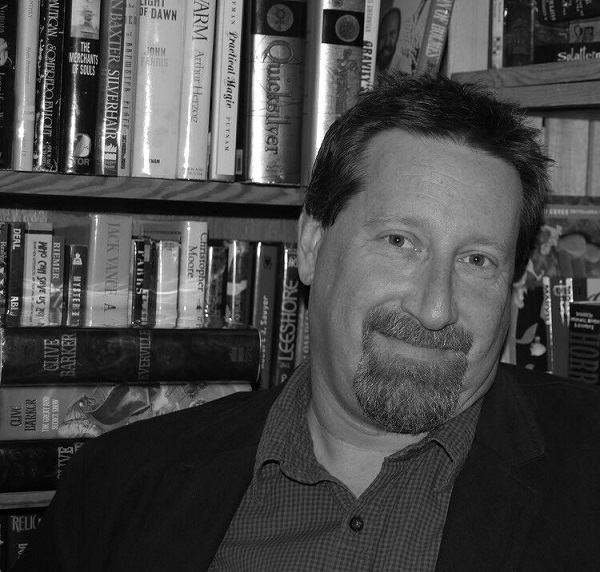
Below is the sixth in our series of author interviews celebrating Cosmic Horror and Cthulhu Mythos Month by investigating how authors define the terms. Thanks to author Pete Rawlik for his time and comprehensive answers!
Below is the sixth in our series of author interviews celebrating Cosmic Horror and Cthulhu Mythos Month by investigating how authors define the terms. Thanks to author Pete Rawlik for his time and comprehensive answers! Check out our Cosmic Horror and Cthulhu Mythos Page for more interviews and original fiction.
How do you define the term Cosmic Horror?
Casual readers of weird fiction often tend to use the terms Cosmicism, Cosmic Horror, Lovecraftian Fiction, and Cthulhu Mythos interchangeably. This is not so much problematic as it is a misunderstanding of the terms, or more precisely a failure amongst the literati and critics to create and maintain a vocabulary for such literature that differentiates between them. And to be clear I firmly believe that there are differences, one might even say speciation between the various terms that are routinely thrown about and used interchangeably. In order to clarify my point(s), I am going to start at the topmost generality and work my way down towards more specificity. This is going to be just a cursory glean, because honestly, what we are talking about is worthy of a Master’s Thesis.
Cosmicism in brief is a literary movement within Science Fiction, Fantasy, and Horror that posits the position that the universe as a whole is non-anthropocentric. That is to say that in the great scheme of things, the wants, desires and morality of humans as individuals or as a species are insignificant. The universe doesn’t care if you are a good person, it doesn’t care about your soul, it doesn’t care about your wife or children, it doesn’t care about literature or art, and it certainly doesn’t care about the rise and fall of nations or religious institutions. To quote Larry Niven “Mother Nature doesn’t care if you’re having fun.” At the scale of the universe, anything you and yours might do is completely insignificant.
There are part and parcel to this idea of cosmic insignificance, two factors of scale. First the universe is very big, vast even. To paraphrase, the universe is not just bigger than you think, it is bigger than you can think. The same can be said of time, which is the second factor of scale that’s integral to the discussion of cosmicism. In both cases the central idea is that no matter what you achieve, it only has miniscule meaning as space and time are so large that any such events are ridiculously localized, and fleetingly ephemeral. Blow up the planet and honestly the universe won’t even notice what is essentially a tiny burp in the outer arm of one rather pedestrian galaxy amongst uncountable others.
These ideas are illustrated by a number of pieces of fiction including Olaf Stapledon’s The First and Last Men, Arthur C. Clarke’s Childhood’s End, H.G. Wells The Time Machine, Fred Hoyle’s The Black Cloud, David Brin’s short story The Crystal Spheres, and Bruce Sterling’s short story Swarm. In Lovecraft’s work the prime example of this is his collaboration with Robert Barlow, Til A’ the Seas, while Beyond the Wall of Sleep fits as well.
While cosmicism is often considered a very serious genre, it can often be used humorously, in a sub-genre that could be considered cosmic humor, or cosmic absurdism. In this grouping, the tropes of cosmicism are played out for laughs, suggesting that the native state of the universe is simply ridiculous and the only response might be to laugh at it rather than go insane. Examples of this include Douglas Adams’s Hitchhiker’s Guide series, Johnathan Lethem’s As She Climbed Across the Table, Phillip K. Dick’s The Game-Players of Titan, and Cordwainer Smith’s short story The Game of Rat and Dragon.
Opposing cosmic humor is obviously cosmic horror, the fundamental tenet here is that not only is the universe not anthropocentric, it is whole heartedly anti-anthropocentric, in other words, the universe not only doesn’t care about you and yours, but it is specifically set up to destroy or consume life as you know it. In another sense, the universe is antithetical to humanity or anything like it. Works that fall into this category include Vandermeer’s Annihilation, the film Event Horizon, the gaming universe for Warhammer 40,000, and David Langford’s Basilisk stories. Note here that while Event Horizon and Warhammer 40,000 present milieus that are actively antagonistic to humanity, or whole varieties of life, Annihilation and the Basilisk stories present phenomenon that aren’t particularly antagonistic, they simply exist and have stumbled upon mankind, or vice versa. In this sense, some alien invasion stories could fall into this category including Finney’s Invasion of the Body Snatchers and Wyndham’s The Midwich Cuckoos.
How do you define the term Cthulhu Mythos?
Lovecraftian Horror is best described as a kind of bridge between cosmic horror and the core tenets of the Cthulhu Mythos. So, we have to back engineer things here and define what exactly is a Cthulhu Mythos story. In general, Cthulhu Mythos works focus first on the setting, which is Arkham and the rest of Lovecraft Country, or in the rest of the world and universe that includes or at least doesn’t preclude such locales. The second defining factor is a focus on non-human life intruding into the setting, particularly life forms from other dimensions or alien worlds that are not humanoid. Aliens with radial symmetry, a complete lack of symmetry, or being only partially comprised of matter as we understand it are dominant. There might also be a preponderance of tentacles and slime. There goes hand in hand with this alienness a theme of miscegenation in that the alien life seeks to combine or corrupt some facet of terrestrial biology or ecology. Finally, there may be an overwhelming sense of deep time, that while the narrator may be encountering events in the now, the extent of these events might stretch backwards or forwards far beyond human history, or even the existence of humanity. This definition places works like Lovecraft’s “The Colour Out of Space,” “At the Mountains of Madness,” “The Dunwich Horror,” and the “Shadow Out of Time” clearly into the Cthulhu Mythos. Stories such as “The Shadow Over Innsmouth” could be argued in either direction. In contrast, “The Thing on the Doorstep” and “Herbert West – Reanimator,” may be set in Lovecraft Country, but should be excluded from the mythos, perhaps for a more inclusive Lovecraft Country setting – one could imagine a whole series of stories set in the Miskatonic Valley that are consistent with the Cthulhu Mythos, but are not connected to any monsters, perhaps a medical drama set at St. Mary’s in Arkham, or a police procedural set in the rough town of Bolton.
So, what then is Lovecraftian Horror? It is a genre that borrows some of the specificity of the Cthulhu Mythos but works to avoid others. Both Larry Niven’s World of Ptavvs, and John Brunner’s The Atlantic Abomination mirror much of Lovecraft’s “The Call of Cthulhu,” but they are clearly not part of the Cthulhu Mythos. The same might be said of the films The Void, and Horror Express. It wouldn’t take much to push these into the Cthulhu Mythos, but the original creators didn’t do it.
There are even works by Lovecraft that fall into this category. Fans – including myself – tend to lump Lovecraft’s “Dagon,” “The Music of Erich Zann,” and “From Beyond” into the Cthulhu Mythos but as independent stories they fall better into the category of Lovecraftian Horror, or at best proto-mythos stories. Rick Lai has made a good argument that “Dagon” could be considered an early draft of “The Shadow Over Innsmouth.”
It is important to note here, by these definitions, not everything that Lovecraft wrote is part of the Cthulhu Mythos, nor could it be considered Lovecraftian, Cosmic Horror, or even Cosmicism. Indeed, I would argue that a great number of works often considered as examples of Lovecraftian or cosmic horror are simply not. For example, Ridley Scott’s film Alien is often cited as an example of Lovecraftian or Cosmic Horror. However, while it shares the trope of slime and tentacles and a very alien (though still bipedal) monster, the biomechanical nature of the xenomorph is not Lovecraftian, and if you strip away the sci-fi trappings this is a story about a group of travelers encountering a deserted house in which a predatory monster/ghost/demon then proceeds to kill everyone. There is really no sense of cosmicism inherent to the story.
Likewise, there are many other works that borrow heavily from the mythos but simply can’t be included in the mythos whatsoever. Examples of this include DC Comic’s Icthulhu, and the Doom That Came to Gotham, Marvel’s Shuma Goroth and the N’Gai, Richard Corben’s Den (Uhluthc), Mike Mignola’s Hell Boy, amongst others. I think of these as Mythos adjacent, with authors borrowing from the sub-genre, but transplanting it into their own work, rather than contributing to the mythos itself. This pattern is often prevalent amongst new writers who tend to latch on to the public domain status of Lovecraft’s work and use it as a kind of literary soapbox to stand upon, without really understanding what defines the mythos, and what doesn’t. The prevalence of mythos works mixed with other religions, particularly categorizing mythos entities as Christian devils and demons is for the most part rather frustrating.
What I have left out of here are the fantasy worlds that have grown up with the mythos, such as the works of Robert E. Howard, Clark Ashton Smith, and Richard Tierney. Like a whole gaggle of other work, these stories, particularly the Conan ones, drift in and out of the various definitions I have provided above.
As much as I find a significant amount of work in the genre sub-par, (both as a writer and reader) I think it is important to encourage new authors to experiment and take the mythos in new directions. Without such efforts the Cthulhu Mythos would face potential stagnation. The best example of this is the Delta Green books, Charles Stross, and Caitlin Kiernan.
Can you recommend a tale of Cosmic Horror, in the Cthulhu Mythos, or both?
As for recommendations, that is a tough one. But I will give it a shot but lean toward more modern writings
Cosmic Horror Recommendations
John Langan’s The Fisherman
Laird Barron’s The Croning
Caitlin Kiernan’s Threshold
Whitley Streiber’s The Forbidden Zone
Lovecraftian Fiction
Edgar Cantero’s Meddling Kids
E. D. Klein’s The Ceremonies
Fritz Leiber’s The Dealings of Daniel Kesserich
John W. Campbell’s A Frozen Hell
Graham Masterton’s The Wells of Hell
Cthulhu Mythos
Ramsey Campbells’s Darkest Part of the Woods
Frank Belknap Long’s The Horror From the Hills
Colin Wilson’s The Mind Parasites
Graham McNeill’s Ghouls of the Miskatonic
Fred Van Lente’s Weird Detective
Mythos Adjacent
Mike Mignola’s The Doom That Came to Gotham
Robert Bloch’s Strange Eons
Ed Brubaker’s Fatale
Michael Alan Nelson’s Fall of Cthulhu
Paul Wilson’s The Keep
Can you recommend something of your own work? Cosmic Horror, Cthulhu Mythos, or Otherwise?
And for things that I have written
Cosmic Horror Recommendations
In the Shadow of the Eldritch (with Sal Ciano) forthcoming
Lovecraftian Fiction
Aysaqendesia
Cthulhu Mythos
Here Be Monsters
Mythos Adjacent
The Nomenclature of Unnamable Horrors
Cosmic Humor
Where Howls the Edg’og
About the Author
Pete Rawlik is a writer and frequent panelist of the Lovecraft eZine based in Florida, where he rules over the Reanimated and supplies strange tomes to delvers into the forbidden. Those interested in his work can find much of it here, and here.
About the Interviewer
Jeremiah Dylan Cook is the author of A Mythos of Monsters and Madness, which includes Cosmic Horror and Cthulhu Mythos short stories. He founded Cosmic Horror and Cthulhu Mythos Month in January of 2023.
One thought on “Author Interview with Pete Rawlik”